twist, an audio feed to let the user hear what the meter reads.
Most surveillance guides talk about these things; few reveal how they work.
Design flows from the fact that the meter-drive voltage is audio.
To add sound to a sniffer, feed a tap off the meter to an audio amp.
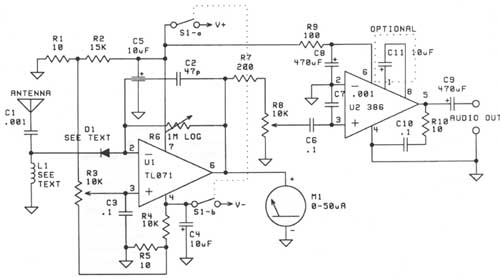
Check out the schematic.
Antenna feed couples through Cl to the junction of L1 and D1.
This arrangement shunts signals above L1-C1 resonance to D1, and shunts signal below resonance to ground.
You can screen out domestic AM radio signals by making L1 small enough.
The prototype used lOuH, whose 1.6-MHz resonance with C1 gives a reasonable compromise between low-frequency sensitivity and rejection of interference.
RF is rectified by D1, which can be a 1N914, but a 1N34A gives the sniffer much greater sensitivity.
A hot-carrier diode, such as 1SS99 or NTE112, works even better.
The reason for this resides in each type’s forward voltage drop.
Silicon diodes take about o.6v to conduct, germanium diodes about 0.35V, and hot-carrier diodes about 0.2V.
Note that D1 is oriented to pass negative peaks. These will be inverted by U1, whose
gain is variable by pot R6. R3 and the surrounding voltage dividers R1-2-4-5 serve as a meter-zero control.
C2 limits U1’s high-frequency response to the audio band.
U1 output drives a 50uA meter directly.
U1 output also couples through R7-8-C6 to input of U2, a 386 rigged in the usual fashion.
C11 is optional and will kick U2 into high-gain mode.
House the sniffer in a metal case for best sensitivity and rejection of local interference.
Be sure to insulate the antenna from the case with a rubber grommet.
To use the sniffer, connect a pair of fresh 9V batteries, power up, set audio gain to minimum, set RF gain to desired level, zero the meter using R3.
To test, bring the antenna near a low-power RE transmitter, such as an old cordless phone
(a walkie-talkie will cork the meter and could zap the diode).
If no transmitter is available, hold the antenna a few inches in front of a
television screen, or about 10 feet from a microwave oven heating a cup of water.
The device has more than enough sensitivity for sweeping and works great for peaking RF-Bugs.
The front end is a classic AM detector.
Despite this, it will demodulate wideband and narrowband FM enough to confirm a meter peak as an audio transmitter.
The richness of the RF environment evident in the audio feed dramatizes why increasing sniffer sensitivity quickly passes the point of diminishing return.