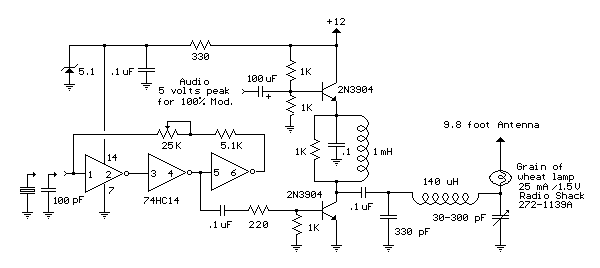
In this circuit, a 74HC14 hex Schmitt trigger inverter is used as
a square wave oscillator to drive a small signal transistor in a
class C amplifier configuration. The oscillator frequency can be
either fixed by a crystal or made adjustable (VFO) with a
capacitor/resistor combination. A 100pF capacitor is used in
place of the crystal for VFO operation. Amplitude modulation is
accomplished with a second transistor that controls the DC
voltage to the output stage. The modulator stage is biased so
that half the supply voltage or 6 volts is applied to the output
stage with no modulation. The output stage is tuned and matched
to the antenna with a standard variable 30-365 pF capacitor.
Approximately 20 milliamps of current will flow in the antenna
lead (at frequencies near the top of the band) when the output
stage is optimally tuned to the oscillator frequency. A small
'grain of wheat' lamp is used to indicate antenna current and
optimum settings. The 140 uH inductor was made using a 2 inch
length of 7/8 inch (OD) PVC pipe wound with 120 turns of #28
copper wire. Best performance is obtained near the high end of
the broadcast band (1.6 MHz) since the antenna length is only a
very small fraction of a wavelength. Input power to the amplifier
is less than 100 milliwatts and antenna length is 3 meters or
less which complies with FCC rules. Output power is somewhere in
the 40 microwatt range and the signal can be heard approximately
80 feet. Radiated power output can be approximated by working out
the antenna radiation resistance and multiplying by the antenna
current squared. The radiation resistance for a dipole antenna is
80*pi^2*(length/wavelength)^2 which yields about 0.2 ohms for a 3
meter dipole at a frequency of 1.6 MHz. Radiated power at 20
milliamps is about I^2 * R = 80 microwatts and for a grounded
system with a single element whip antenna, the radiated power is
about half that, or 40 microwatts.
Ritningen kommer inte från mig !